Prelude
Being bad at doing tasks in small regular chunks, I overtook the task of writing this article with several bursts of productivity. That's how I roll. Contrary to the instructions, you, the reader, should keep in mind that this very text is in no way, shape or form written in a diary-like basis and thus is not structured so. The text is structured more like a collection of short essays. However, this chapter contains only the opening words and I have no intention to prolong this paragraph for no reason.
The following chapters, or essays if you will, contain retrospective reflection along the themes of user experience, experience-driven design, human-centred design, etc. In the text I discuss how I built on prior knowledge during the autumn semester of 2022. I will be describing the ideas and concepts I absorbed as well as how I became more aware professionally. The last chapter attempts to summarise everything and wrap it up into a nice little box of conclusions.
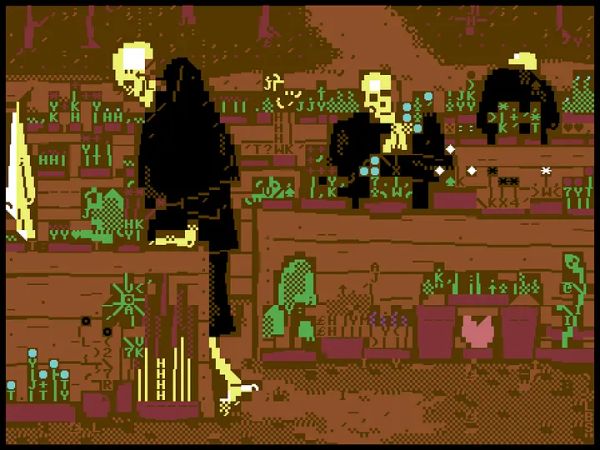
As a side note, I originally used the docx template provided to structure this document. The vernal bloom of the front page not suiting me, I decided to change it into my PETSCII interpretation of Hugo Simberg's Garden of Death. I found it suitable as it represents how the project went pretty accurately — despite all the hardships we went through the outcome wasn't as eligible as I initially pictured but lots of seeds of learning were sown along the way.
Apologies in advance if there is too much text and thoughts in this learning diary. I admit it can be a bit excessive but so was the course and the experience. I personally think this kind of self reflection could and should represent a larger portion of the overall credit as what is being a designer if not self-consciousness.
The Initial State of Affairs
My background is one of the most typical ones — maybe even the most generic: I have a bachelor's degree in information and communication technology. I've always been noticing usability issues and getting frustrated over, what some might regard as, minor details. That being said, I've been consciously observing my environment since I can remember. During my bachelor's degree studies, I took one mandatory course on UX and didn't like the teaching at all as it wasn't really about UX. They called it “heuristic evaluation” when an engineer evaluates the UX and UI. At the time, I wanted to further my knowledge on the topic by taking some additional courses through the cross study portal. Unfortunately, I had too much work finishing the courses and writing my bachelor's thesis that I never took the fundamental courses. However, the spark remained and I applied for the Human-Technology Interaction master's degree programme and got in!
During these studies, I found that I can include my personal and somewhat strong values into my work in this field. I am a sustainability advocate and I've been switching my old habits into their sustainable counterparts one by one starting in 2017. Currently, I'm personally working on cutting down on the amount of my possessions while trying to maintain the perks of the current situation. This will get me a bit further on the path of sustainability. I strongly believe in the mental health benefits from decluttering and minimalism. Back to the actual business, I really loved the course Sustainable Design by Professor Thomas Olsson. Whilst on the lectures, I knew this is something I would like to spend my career years on. Despite the fact that sustainability design is not currently a thing, and I do check regularly if there's any available positions with related titles and there haven't been any, I'm aiming to market myself as one as soon as I graduate. This is the very reason I look for project topics around this theme on every single course. If there's no matches I don't hesitate to make my own suggestion, which I usually end up doing. I know that for designer roles it's desired to have a portfolio. Mine is going to be, and actually, is already, filled with sustainability-related projects and essays.
To be honest, I cannot distinguish the three design courses I have at the same time. At least not yet. However, I'd hope that the projects, from this point onwards, would be more lifelike — to contain both the user studies and the evaluation. Prior to this course, I've only been involved in either designing something or evaluating something. I really feel I haven't really gotten to the connection of the two. In conclusion, I expect to get to explore the connections I haven't had time to venture into previously.
Professionally, there's still so much to learn: the design process in its entirety isn't clear to me, I do not feel too confident with the software I've been learning, and I know enough to know how little I actually know. Take this with a grain of salt as I strive for perfection and I'm very self-critical. I feel like I need to be better to really serve my purpose as a spokesman of sustainability. At least professional skills will give me more foothold no matter the cause. I do not settle for the average; good salary and whatnot. I need recognition and to have a voice. My goals might be ambitious but the design field isn't my only resort. However, I need to make the most out of it to feel complete.
I wish to face challenges! I love it unless it's about not having enough time. Those are the worst as I'm always busy with my hobby projects and I'm not willing to steal time from recreation. I cannot sustain that mentally! The kind of challenges I'd like to face are about themes, methods, the design itself, or the practicalities of the evaluation. Considering myself confident, I would really like to face something I have no knowledge about. Learning is one of the best feelings and a good investment for the future. Additionally, I'm the kind of know-it-all or jack-of-all-trades person so I'm not afraid of the unknown! The unknown just needs to be explored. I wish I got to do that more often.
Laziness tends to occupy me from time to time. That's why in this chapter I promise to do things as soon as possible. I do not mean as soon as I can but to start the mental work immediately when the task is given. At the time of writing, I can say I've already been successful at practising this and I do not intend to fail doing so. Procrastination is a beast I intend to overcome once and for all this autumn!
Choose Your UX Models Well
The designer's perspective is never the same as the intended user's. Hassenzahl's model seeks to address this paradigm — it offers the designer a way to see the product or service from the user's perspective. This is extremely helpful as each user is an individual and will have their own unique experience when using the product or service. The product's features shape the experience and, without going too much into detail, Hassenzahl's model splits the product attributes into four categories: manipulation, stimulation, identification and evocation. Additionally, the model splits product characteristics into pragmatic and hedonic attributes. However, they're intertwined very closely: if something doesn't work properly it cannot really evoke positive feelings and if something works perfectly but is boring it's not a pleasant experience either. A lot has been fit into a simple-looking model.
People are unique no matter how hard we try to categorise them — every person is a complex system that we cannot say to understand perfectly. Any given product or service can be used in many ways, usually even more than the designers initially designed the product or service for. User experience is the multiplication of the many ways of using the product and the user's personal traits, prior experiences, world views, attitudes and so forth. It goes without saying that each experience is unique. From the first hearing, designing user experiences seems like an impossible task. This is where UX models come into play; they're the tools which the designer relies heavily on. However, they're only models for a reason — the current consensus is that it would be next to impossible to curate a perfectly similar experience for every single user. There are a million times more possible user experiences than users in any given product or service.
In our project, we attempted to utilise the Aware UX Model. It's been constructed from empirical data from the users and it consists of three stages of interaction: the before, during and after stage (Maya & Ariza, 2020). It was somewhat difficult to apply the model as we had both primary and secondary experience goals, two sets of stakeholders that need to be taken into account in the design. Additionally, we faced issues as each of us had a bit different understanding of the model as it's very complex. We found it difficult to utilise the model's Before stage and ended up overlooking that stage. Anyway, my understanding of this model is that it works better when analysing the user experience of an existing product. At least the Before stage makes a whole lot more sense in that case. Despite these issues, we found the model's second stage, During stage, helpful when deciding on the UX goals, especially the designer's. For example, the model uses the word enjoyable but in our context we interpreted it as confidence of use. Additionally, we tried to make the described “flow” a part of our design. As mentioned in our final report, we would have benefited really much from evaluation done in real context. We didn't manage to confirm the experiences that were intended to arise from the Aware UX Model's After stage — to this day, we're unsure whether designers would find our design helpful or not and if there are too many pressing personal concerns. In conclusion, I personally think we chose the wrong model for our project but, to our defence, we couldn't foresee the twists and turns the project took.
The purpose of UX models, according to my understanding, is to help the designer to understand beforehand what kind of experiences the user might get to experience. They put more focus on the abstract experiences than concrete features. UX, nonetheless, is a sum of hedonic and pragmatic attributes. I think some UX models are better suited for analysing than designing and vice versa. I would recommend utilising UX models in the design process as they're based on evidence and they lighten the mental load but they're not the only truth to follow. In the end, it's not exact science but models to guide you — it's not wrong to deviate from the path.
Experiences Translates to How People Feel
Experience-driven design (EDD) focuses on the experiences the product or service delivers on the user. It is not what the system actually does or implies to do — it's about how the system makes the user feel. In EDD, the user is not in the spotlight, evoked experiences are. I'd say experience-driven design is applied right when evaluation confirms the initially set experience goals. However speaking from a tiny bit of experience, the experience goals are not set in stone; they can evolve or reshape. As the course and our project was a rollercoaster of experiences and emotions, I'm a bit shaken if the course staff didn't design this very course by utilising EDD.
During the project, we had to rethink our experience goals on a weekly basis — the feedback we got stated always that we're not describing experiences. I personally had to dabble with the concept of experience a bit to really understand how vague but measurable the goals should be. I would've liked the goals to be a bit more concrete but I can clearly see why one would choose to base their designs on user experiences. To me it feels a bit cheating as the product or service has to only convey the experience, or feeling of something. That doesn't include that the product or service should actually do something. For example, if the goal is to make the user experience happiness we don't have to focus on fixing what's preventing them from feeling happy. Instead we can just make them experience happiness momentarily. I see this as a bit alarming as misusing EDD might lead to unethical decisions.
To put it bluntly, my understanding is that EDD cares only about the experience received; it's the hedonic facet of Hassenzahl's model. However as discussed before, good hedonic aspects require workable functionalities and the other way around. This being said, I don't see a way to only use methods of experience-driven design. The fact remains that no designer should blindly focus on EDD alone. I'm assured putting effort into designing user experiences will produce commitment, or value if you allow, to a product but it's a difficult angle to start the design work from. I personally wouldn't start designing from scratch using this method. I would most likely utilise EDD in the second or later iterations.
However, EDD is a tool I'll gladly adopt though I do not think it's enough by itself. During the project we gathered different commonly known design methods and I think choosing the appropriate ones for any given project has major impacts on the outcome. With the proficiency I have gathered this far, I can safely say that no designer should use the same few methods they like in every project. True mastery, as in arts, comes from knowing which methods and approaches to mix and when. No method is one-size-fits-all.
Evaluation Is A Necessary Evil
Without further ado, evaluating user experiences requires a highly-functioning prototype. It doesn't need to be a hi-fi prototype, the main functionalities have to be working well enough to evoke experiences in the user. This was not pointed out in the course materials or any other sources well enough. This is something we learned by trial and error and I wanted to put an emphasis on it.
Evaluating user experiences is done in a momentaric, episodic or long-term manner. Data can be collected by observing the test users, taking psychophysiological measurements, or via self-reporting of which the latter seems to be favoured. Lots of methods specifically-designed exist for self-reporting, such as PANAS, Affect Grid, PrEmo, AttrakDiff, meCUE, iScale, and UX Curve just to name a few. More traditional methods like questionnaires, interviews and diaries are also used for the same purpose. User experiences can be also measured with comparative studies much like A/B testing. Different methods are curated for different time frames and that's why it's most important to choose the most suitable methods for any evaluation. The phase of the product development affects the evaluation methods as well as the evaluator's experiences with different methods. Usually, the data produced is qualitative but in some cases quantitative data can be gathered as well. In addition, collecting qualitative data might prove more cost-efficient. The evaluation process should be simple and easy to understand for the test users thus piloting the evaluation doesn't hurt.
In our project, we discussed evaluation and quickly landed on the fact that the time is running out. In practice this meant that we chose the methods we were used to and started implementing those. Basically, we conducted semi-structured interviews and we generated the questions from the experience goals. The questions were colour coded and mixed so that the flow of the interview would be as natural as possible. We had hidden a question that would verify our concept idea among the other questions. This was another method in use. Later, we used the good old context analysis method to see how the user experience goals were met.
We analysed the data based on how many positive and negative answers each of the goals got. However, it was evident that our prototype wasn't sufficient for this kind of evaluation as lots of the comments were about usability. Our evaluation focused on the user experiences and we didn't care that much about the usability issues although we wrote them down to the list of things to be improved. Making the evaluation practical, tying the goals to requirements, was where we failed. This fizzle would have been avoided by conducting a pilot interview but due to the time restraints it couldn't be executed.
Evaluating user experiences with interviews is hard. What I think makes it immensely difficult is the word choices and language barriers. Describing experiences or emotions specifically using language other than one's native language is not an easy feat. I would say we, as the evaluators, chose words that we felt are the correct ones but the interviewees having different cultural backgrounds would have made a bit different word choices. It's not proven science but I have a strong gut feeling that the data would be more exact and valuable if the evaluator and the test user had the same linguistic roots and the test itself would be in that language. My advice is that cross-cultural user experience evaluation should be avoided if possible. Word choices matter.
I've always considered myself bad at evaluation. It's not something that comes naturally and our project was no exception. I usually know when a design manages to reach the goals in advance and evaluation just proves my hunch. This happened again. I'm not sure if all this is due to the fact that I'm rich in ideas and thinking from different perspectives by nature. This far, I haven't had a eureka moment about evaluation. I'm in the belief that evaluation proves my suspicions and makes the rest of the team agree with them. Maybe the level of my proficiency in evaluation comes from that I don't see too much value in it and thus don't spend time learning it properly. Looking back to the project now, I feel that we should have used some kind of strictly structured evaluation method. Usually interviews are chosen to be the way to go. Maybe I need more experiences, maybe I should trust my gut feeling more. Who knows? At least I've uncovered a weakness of mine and I like it — I have something concrete to improve at.
A Step Forward
Absorbing new information like a sponge, I love learning. Due to this course and other personal and professional experiences I think I've grown a lot both as a person and designer; it has been an experience learning about experience-based design work. We as a team faced issues regarding both technical execution and internal teamwork. It goes without mentioning that it wasn't the most pleasant experience, not what I expected. But how could I have expected all that happened? Despite all that, I don't think the outcome is negative — I learned a lot about working as a team, EDD, user experience design and evaluation, and myself. I'm not perfect and I'm very aware of that. Every day I still learn something new.
I think my ideal career path grows clearer every day — it's now more obvious than ever that working on ground-level products and services which will nudge us in the direction of a greener tomorrow is where I see myself. To this day, I haven't found any open positions with titles like Sustainability Designer. All the positions containing the keyword sustainability are invariably in the field of material and energy engineering. It is evident that I should focus on finding a company that enables me to utilise the knowledge and motivation towards sustainable design and work my way up from there. Maybe working as a project manager of some sort would enable more leverage on the sustainability concerns. In that case, it would make sense to design a sustainability guideline or framework and consult the designers using it. I haven't completely ruled out the possibility of working as a UX researcher but, according to my current conception, that way I couldn't have the same level of impact that I could have working in a private company. At the end of the day, I do not stop being a sustainability advocate.
Besides the aforementioned, during this course I've been thinking about how other people affect my work. Hitherto, I have uncovered that I resonate better with people with some specific traits whereas there are some traits that affect my work negatively. I do not want to share the details as it feels too personal. As much as I'd love to say I get along with anybody just fine, it's not true. I acknowledge this attribute is mental but its effects are tangible. As social sustainability is part of the main concept, I'd really want to develop some kind of team building or team working models that would address this kind of interpersonal issues. Open communication is definitely a part of it but constructing enough mutual trust to share a bit more personal experiences will be tricky given the short time limits when getting to know each other. However, I do not expect working as a team to be happy and fun all the time. This is an ongoing process and I still have lots to learn.
Commenting and giving feedback to other participants on the course felt natural though a bit excessive. As we had already done loads of reading, it felt like a burden to read some more. The style of documentation could be easened. Though, I'm not sure if the course is supposed to guide us to the practices of researchers or not. My intuition says in working life documentation is done either in wiki-style or as a slideshow. That would take some weight off the shoulders of the authors and the ones reading it. Getting feedback was beneficial in places. Other times, it was too generic and not enough thought was put into it; I felt it was wasting the writers and my time. Maybe there should be some rules for giving feedback. I'd say it's useful to hear about new approaches, ideas and concerns in length but comments on the form, grammar and whatnot should be covered in one or two sentences.
Besides the proposed changes to the documentation style above, I would have benefited if there were more emphasis on the fact that the course materials and lectures are there to support the project work. As far as our project is concerned, I feel progressed as we felt the best intuitively, not relying on the course materials or schedule. Also, I think it would be good to not give the whole template in the beginning. Instead, you could give the chapter titles that have to be included in the next submission. This way the teams would probably be more focused on the matters at hand. The aforementioned suggestions on documentation changes would be well suited for this kind of approach. Additionally, I have to mention that our project topic was too large to be finished properly in the given time limits. In retrospect, I wish there would've been more assistance on defining the project. We should have contacted the teachers on this matter back then but we really believed we could achieve what we sought for. It's now all in the past and, oh my, was it a journey.
To summarise all this chatter, I cannot settle for being good at design — I have to aim for mastery to achieve a piece of mind. I'm known for being over-ambitious from time to time but to have a substantial impact on sustainability-related issues I have to achieve high-proficiency in design. It's not a two-year-plan, it might take a lifetime. This is, however, a field that really sparks motivation in me. Again, I was working with a sustainability-related topic and some might say the project was a bit of a failure. Personally I think it was a good lesson about the scopes of projects. Ours was too big to handle but only due to the time restraints of the course. My brain is already gearing up new ideas on how to make this kind of framework available for all sub-fields of sustainability. Thus I know I'm home.
References
Maya, J. & Ariza, N. (2020) ‘The Aware User Experience Model, Its Method of Construction and Derived Heuristics', in HCI International 2020 — Late Breaking Papers: User Experience Design and Case Studies. [Online]. Cham: Springer International Publishing. pp. 211–233.
This article is slightly modified from the original written for the course User Experience: Design and Evaluation at Tampere University.